


Realizado con la colaboración del Grupo Tordesillas y la Fundación Carolina
Abstract
This study investigates polycrystalline NaxCoO2 thin films synthesized via spray pyrolysis on glass substrates over a wide compositional range of x. The films were grown using cobalt acetate tetrahydrate and sodium hydroxide as precursors, employing different precursor solution molarities to control the growth dynamics.
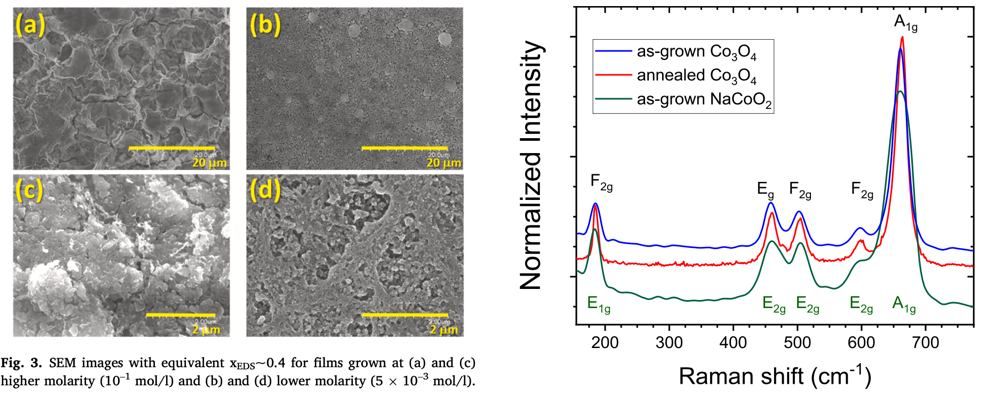
The charac- terization of the system was conducted using X-ray Diffraction, Scanning Electron Microscopy, Optical Trans- mittance, and Raman spectroscopy. Raman spectroscopy revealed oxygen in-plane motion modes under specific excitation wavelengths due to optical resonance conditions and identified the films as γ-NaxCoO2.
The growth of γ-NaxCoO2 phase is favored by a high-molarity synthesis mode followed by an oxygen thermal annealing. At room temperature, films with higher sodium content exhibited decreased Seebeck coefficients and electrical resistivity.
Notably, a maximum power factor of approximately ~3.3 μW/K2m was achieved at x = 0.93. Conversely, films prepared at low-molarities presents Na-content Co3O4 phases and Seebeck coefficients up to 500 μV/K yet suffer from poor electrical conductivity.
These findings underscore the viability of spray pyrolysis as a scalable method for producing p-type thermoelectric layers such as NaCoO2.
Download the study
Download the complete Study


