


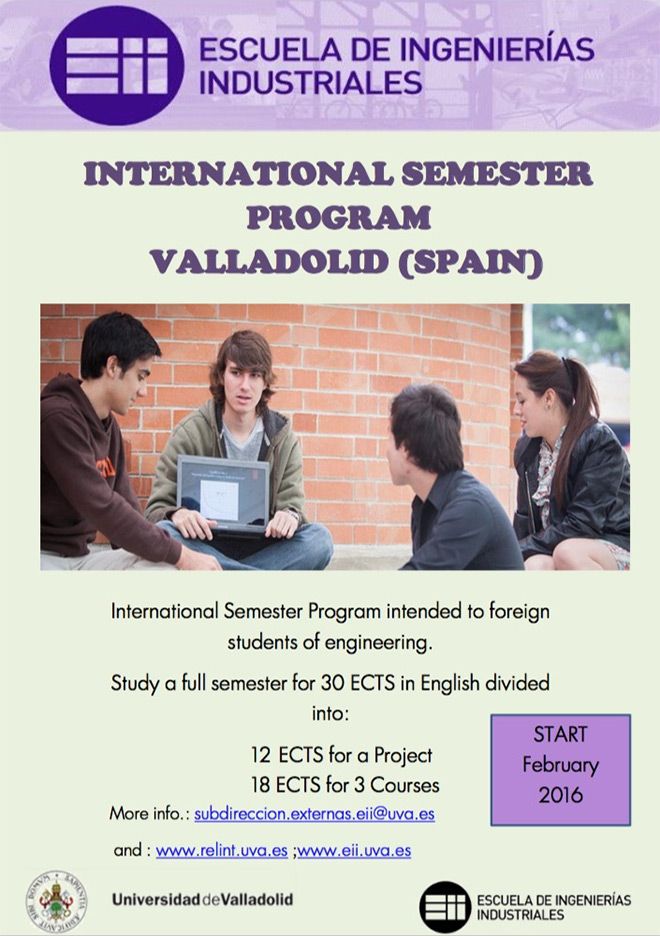
The project offers foreign students a full semester (30 ECTS credits) in English to undertake engineering studies in any of the degrees currently being taught at the faculty.
The proposed structure is as follows:
» 12 ECTS corresponding to the student’s final project.
» 18 ECTS corresponding to three courses with six ECTS credits each, which students choose from amongst six proposed courses, all of which are transversal for the seven bachelor’s degrees taught in industrial engineering. The proposed courses are:
1. Environment and Renewable Energies. – Department of Chemical Engineering and Environmental Technology and Department of Electrical Engineering.
Course description: Environment: Department of Chemical Engineering and Environmental Technology. Industrial activity and the environment. Environmental management. Environmental policy. Life cycle analysis. Design for the environment. Evaluation of environmental impact. Sustainability.
Course description: Renewable Energies: Department of Electrical Engineering. Solar energy fundamentals and solar photovoltaic basics. PV system components. PV systems designing and sizing both a grid- tied system and an off-grid system with battery backup. Hands-on lab: practice with meters and PV system components. Computer simulation lab: practice with simulation software for designing and calculating PV systems.
2. Science, Technology and Society. – Department of Electronic technology
Course description: Link between science, technology and society: historical perspective. Science and technology culture. Technology assessment. Social impact assessment of technology. Public involvement in science and technology. System thinking and life cycle thinking. Science and technology policies. Science and technology ethics. Appropriate technology. Science, technology and gender. Military system, big science and techno-science.
3. Creativity and Innovation in Industrial Design.- Department: Theory of Architecture and Architectural Projects. Area: Architectural Composition
Course description: Innovation in industrial design. Evolution of the discipline, current trends and challenges for innovation. The creative process. Creativity techniques. Design Thinking. Methodology for a graphic project. Visual communication.
4. System Dynamics. Modelling and Simulation in Engineering. – Department of Systems and Automatic Engineering
Course description: System Dynamics: analysis of variables, structure and modes of behaviour. Process and systems modelling. System Dynamics software. Simulation models of elementary processes and of complex systems in engineering. Simulation models related to environment, energy, ecosystems and natural resources. Modelling and simulation of systems and processes found in the economy and society, and with long-term global development.
5. Project Development and Management in Industrial Engineering. – Department of Science of Materials and Metallurgical Engineering, Graphic Expression in Engineering, Mapping Engineering, Geodesy and Photogrammetry, Mechanical Engineering and Engineering of Manufacturing Processes. Area: Engineering of Manufacturing Processes.
Course description: Planning the stages of technical project development. Technical writing. Project planning and management. Analysis and application of technology, components and materials. Study and application of safety and environmental impact rules. Analysis and application of rules, regulations and mandatory specifications. Manufacturing process diagrams. Factory plan designs.
6. Spanish Course.- Language Centre
These courses will also be open to any visiting students even if they are not included in the full semester.
